THE ANCHOR I DIDN’T PLAN
MOVE
2013, maybe 2014—I can’t remember exactly. I had to discard the car. Home loan was sitting heavy. Started commuting to office on my bike. There was this colleague. Junior guy. We got talking one day about reducing costs further. Multiple iterations. Multiple conversations. Finally I ended up buying a new Royal Enfield 350. Bullet.
That’s when the riding started.
This was all in a phase of around three and a half, four months. From selling the car to buying the Enfield to the day we decided: we should take this somewhere And then one day, impulsively, I said it. “We should be riding to Ladakh.” He says, “Okay sir, I’ll be with you.” I said, “No. I don’t need a pillion. You should buy your own bike.”
Another six months. We both have our own bikes. And we ride to Ladakh. One of the toughest and longest rides. Without any preparation for rains. Without any preparation for winters. Just went.
On returning, we wanted to repeat the same experience. Again and again. Maybe in three years, I was termed as a rider who will not discard his bike. People said, “Oh, summer—it’s very hot.” “Winter—it’s too cold.” “Rainy season—anyways it’s tough to ride.” But I stuck to it. As if, like, that’s the logical me. That I wanted to stick to it.
SEE
But as I grew older, my perspective and my approach towards biking changed. It’s not that I’ve given it up. But yeah, I started feeling that, you know, it was very tiring. It made me feel homesick when I was 10, 12, 15 days riding. And in hope of an experience which ultimately did not come across. But then I stuck to it.
And today, even today when I’m recovering from an injury, I am still inclined to ride a bike.
So I started questioning myself: Is it that image or the persona or the thought or the impression that I’ve created? Or maybe the impression that I created, I’m trying to justify by continuing to ride it? Or is it really that which keeps me going?
On different moments, different thoughts. But that’s the core.
Here’s what I see now: When someone questioned why I ride, I had very smart, street-smart kind of answers. Logical-sounding reasons. Brilliant justifications.
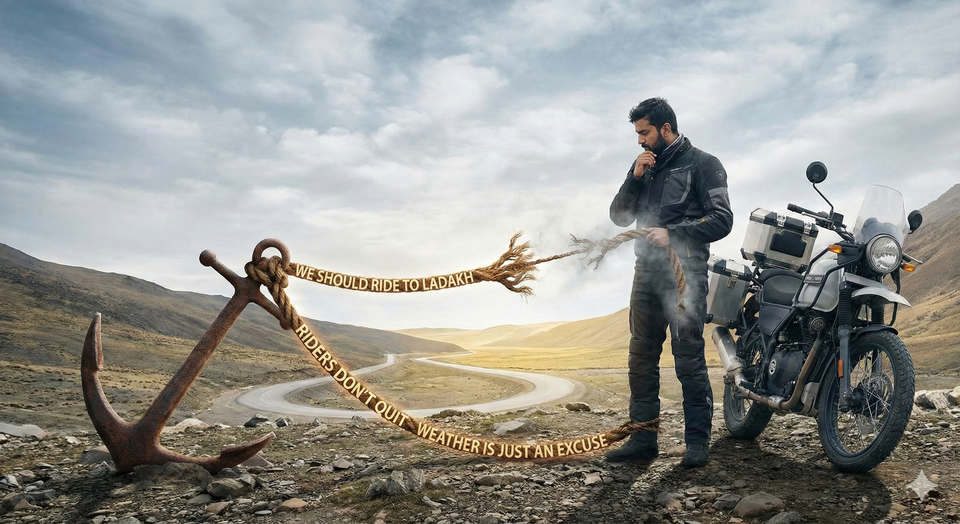
“Riders don’t quit.” “Weather is just an excuse.” “Comfort is overrated.”
All sounded right. All defended well. But on very rare occasions, you realize that, you know, you are trying to justify something. And that may not be the right way.
Justification doesn’t mean you’re right. It is sometimes also like camouflage. Or maybe telling a lie to yourself—this is why I want it. Nobody expects that, because the questions can come. But the best question to answer is the one that comes from within.
Was I riding for me? Or was I riding for the persona I created in those three years? The anchor wasn’t the bike. It was the declaration. “We should ride to Ladakh” wasn’t a plan. It was an impulse. But once I said it—once I did it—it became who I was.
And once it became who I was, I wasn’t choosing anymore. I was defending. You don’t get carried away with anything initially.
But then don’t stick to it. Don’t showcase your commitment of that kind. It’s just a moment. It’s a thought. It comes. It goes. But I stuck.
REFLECT
Today, if I look at myself from the guy who was like 15, 20 years old back—that observation is making me feel less detached, less overthinking, and even more in control. And then I’m taking it all in stride. As if I am a soul, just witnessing the body and mind.
I haven’t given up biking. The bike’s still there. But I’ve stopped defaulting to the justification. Old me: “A rider rides in any weather.” Current me: “Do I actually want to ride today?” Some days I ride. Some days I don’t. But I’m no longer the guy who “rides in any weather.” I’m just the guy who sometimes rides.
The difference? Identity says, this is who I am, so this is what I do. Choice says, this is what I’m choosing today. One locks you in while the other keeps you free.
The lesson, I learnt is watch for the moment when a decision becomes a declaration. And the declaration becomes an identity. And the identity becomes something you have to defend—especially to yourself. That’s when you’ve stopped choosing. That’s when justification takes over.
At this realization take a pause and ask, am I choosing this today? Or am I defending what I said yesterday? The anchor isn’t the activity. It’s the story you tell about why you do it.
Sabri se sabra seekho. Remember Sabri from the Ramayana—but you won’t have to wait your entire life. Just long enough to catch yourself justifying. Then let it float.
Member discussion